

HELLAS HEM
Client
Hellas Hem
Job Description
- Business audit & Analysis
- Business transformation
- Change management
- Sales training
- Coaching & Mentorship
Summary
Hellas Hem asked for marketing support, but our audit revealed a deeper issue: rapid growth had outpaced its sales structure. We rebuilt the commercial foundation – centralising sales leadership, unifying processes, aligning targets, and designing a fair incentive model. One year later, the organisation operates with clarity, coordination, and confidence, finally ready to build marketing on a solid, scalable base.
The Hidden Challenge of Growth:
How We Helped Hellas Hem Reinvent Its Sales Function
Background
A market leader at an inflection point
Hellas Hem is Bulgaria’s leading supplier for the pastry and bakery industry – a 32-year success story built on sharp business instinct, discipline and adaptivity.
Founded by Angel Balyo in 1993, the company was the first in Bulgaria to introduce innovative, scientifically developed ingredients and technologies in pastry, confectionery, bread and ice cream production.
Today, Hellas Hem serves both Bulgarian and international clients with a portfolio of 3,000+ products and a double-digit multimillion turnover, holding roughly 60% market share in its segment in Bulgaria – the undisputed leader in its category.
The company had grown steadily for decades. But as often happens, growth brought friction.
When Angel came to us, his request sounded straightforward:
“We’ve never had a dedicated marketing function. We handle marketing ad hoc, we improvise, but we’ve reached a point where we need a proper, effective setup. Can you help us build it quickly and efficiently?
We said yes – but we didn’t rush to start running ads, launch campaigns or reaching out to influencers.
When companies say “we need marketing”, what they usually mean is: “something isn’t working the way it should”.
The obvious fix is “add more marketing”.
In reality, the root cause is often deeper – in structure, processes, or alignment.
So we insisted on starting off with a fast but thorough audit of how Hellas Hem operates, markets and sells its products.
1. Audit & Diagnosis: Seeing the whole system
Companies rarely see themselves clearly from the inside. Symptoms are visible – slower growth, tension between teams, inefficiencies – but causes stay hidden.
That is why, like a good doctor, we always begin with a full diagnosis, not assumptions (even when they come from the CEO).
To understand where things really break, you must look at all three layers of the organization:
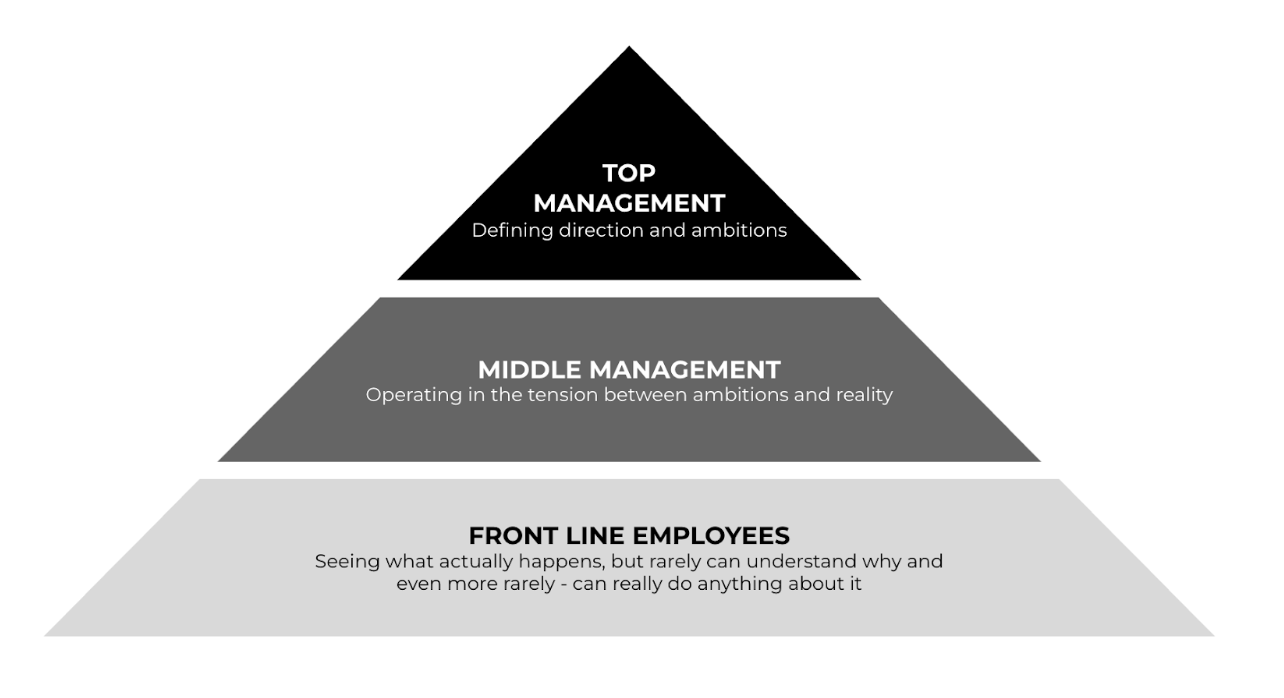
Each level holds only part of the truth. When you look across all three, the full system becomes visible – where direction gets diluted, where priorities diverge, where alignment softens, and how well the company strategy is translated into front-line actions and customer experience.
OUR DIAGNOSTIC PROCESS
1. Discovery
We started with open conversations with the top management (in this case Angel Balyo) to understand how the business runs day to day and where he senses friction. This is where we form our first hypotheses.
2. Interview design
Then we designed a structured interview plan: who we need to speak to and what we need to ask, so we can test those hypotheses and go deeper.
3. Structured interviews
We conducted 11 one-on-one interviews across all levels:
- 3 with top management (board of directors)
- 3 with middle management (supply & logistics, product, regional manager)
- 5 with front-line employees (designer, sales reps, delivery driver)
Here we were looking for context and contrast – how one level perceives the same situation compared to another. These differences expose the real issues: communication gaps, conflicting priorities, and processes that no longer serve the company’s scale.
4. Insight mapping
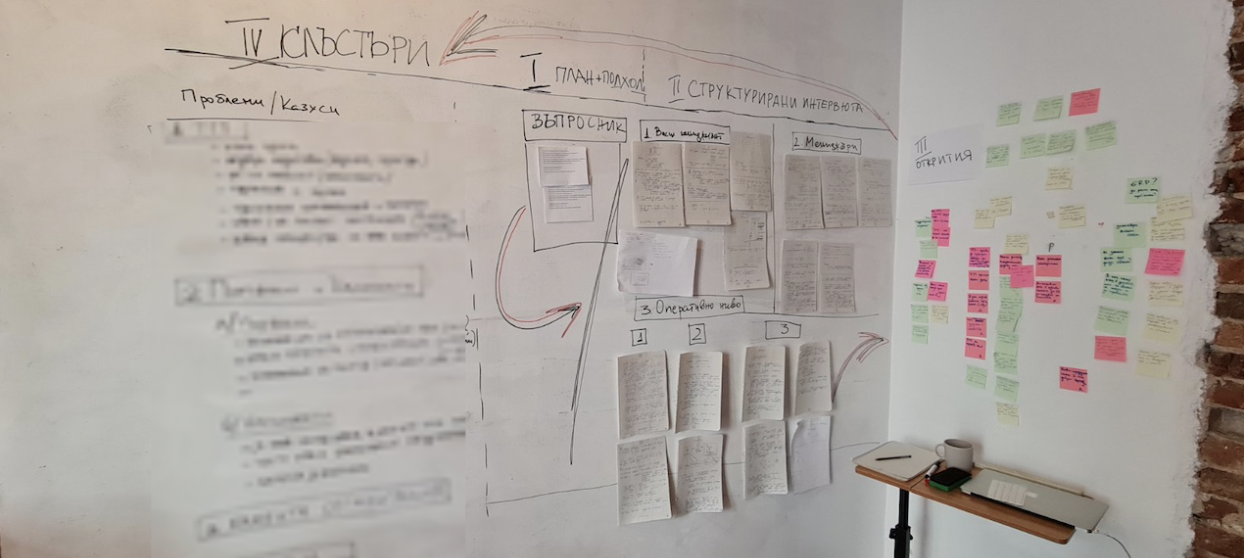
Then we put everything on one wall. Literally.
And we always use sticky notes in different colours for each organizational level (colour-coding).
This simple two-step technique turns qualitative data into a visual map of organizational health. When you step back, you can literally see where the chain breaks. Where communication stops traveling. Where priorities clash and people with the same good intentions end up pulling in different directions.
5. Clustering & analysis
Finally, we grouped insights by topic (“clustering”) and isolated the few structural issues quietly responsible for most of the friction.
What We Found
A clear image emerged:
Hellas Hem’s growth had naturally created complexity, and some parts of the sales function were operating in a more decentralized, legacy rhythm than the company’s current scale required.
Several improvement areas emerged – all common in fast-growing companies:
- Teams working with different local practices and approaches
- Key processes relying on personal habits rather than unified company standards
- Planning and coordination happening in varied formats
- Lacking or limited goal-setting and performance tracking processes
Hellas Hem didn’t have a marketing problem.
It had a structure that had outgrown the informal systems and “startup reflexes” that once powered its success.
At this stage, adding a marketing department would have been like pouring perfume into an engine that needed oil.
When we presented our diagnosis, the CEO paused… and said:
“I don’t know how – in just three weeks – you managed to understand us and our problems and describe them better than we can. Your diagnosis is 100% on point.”
Our approach to driving change
We prepared an action plan with clear priorities – where to start, what comes next, and what must wait.
The fix Hellas Hem needed wasn’t cosmetic. It wasn’t about campaigns, tools, or quick wins.
It was about restoring balance in the company – reducing friction through clarity, structure, and process.
We work with a simple principle:
Meaningful transformation does not start with action.
It starts with a precise diagnosis – the ability to pinpoint the one or two underlying issues, the real leverage points, and the discipline to focus on them first.
Once those are addressed, the whole system stabilizes, giving you a solid foundation to build on and a strong stepping stone for introducing further improvements.
Our Change Management Philosophy
When we drive organizational change, we follow a disciplined cycle:
- Build dissatisfaction with the status quo – make the need for change visible, challenge old routines, and reduce resistance.
- Unfreeze the current model – implement the change (introduce new processes, structures and ways of working etc.)
- Refine and embed – test, adjust, and stabilise the new practices until they stick.
- Freeze – once the new behaviours turn into habits, the change “freezes” and becomes the new status quo. We are now ready to start the process again and implement other changes.
This process ensures changes actually get absorbed, not carelessly announced (and forgotten a month later).
Our Initial Hypothesis – and Why We Pivoted
Our initial recommendation was to implement a simple Sales & Operations Planning (S&OP) process – a unified monthly cycle connecting sales forecasts, supply planning, and operational decisions.
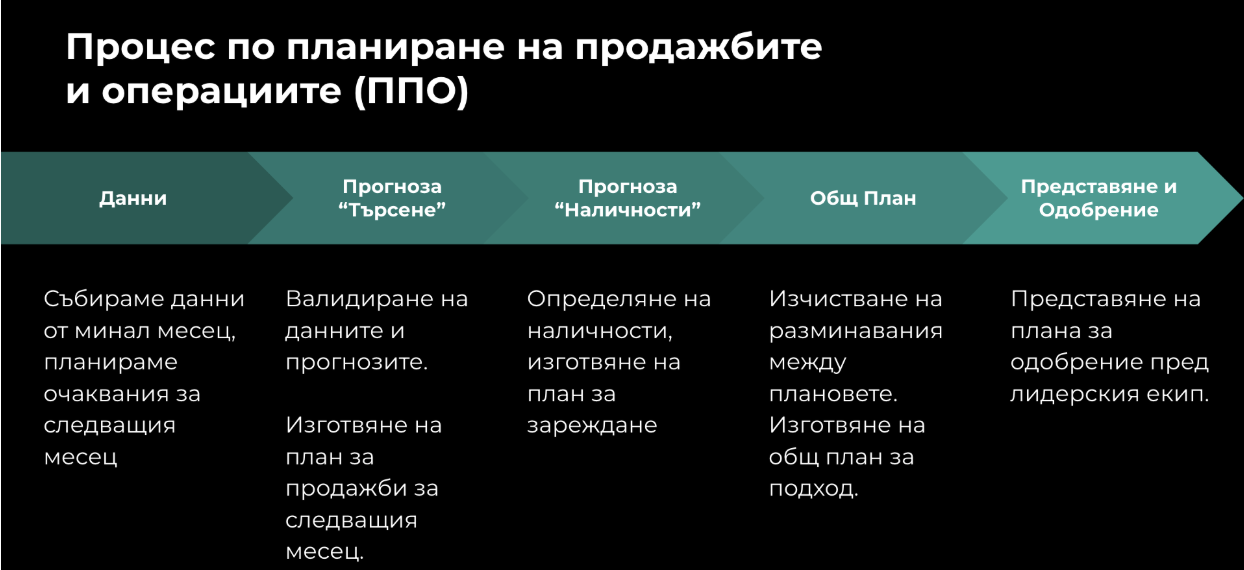
But as we started designing it, we discovered that Hellas Hem’s Operations and Supply functions were working well. Their processes were stable and delivered good results.
The real friction was elsewhere.
The Sales function was the part of the business creating noise and inconsistency:
- Six regions working independently
- No shared targets or planning rhythm
- Incentives rewarding individual wins over company success
If we tried to layer S&OP on top of this, it would collapse under its weakest link.
So we pivoted -> we focused on the S in S&OP.
Before building a company-wide S&OP cycle, we needed to fix the Sales function – and in parallel centralise Product Management, so both functions could work in alignment.
So we scratched off the implementation of an S&OP process and we focused on two decisive moves:
- Rebuilding and centralising the Sales function
- Creating two central leadership roles: Sales Director and Product Manager
EXECUTION
In Summary
We didn’t start with complex processes.
Our execution focused on building a strong commercial backbone.
- Centralized the Sales function – we first established central leadership for the sales function, then introduced unified targets, performance routines, and clear standards across regions.
- Introduced central Product Management – in parallel, we formalised Product Management to improve coordination and support the founder’s long-term succession plan (preparing the next generation for leadership)
- Revamped the bonus model – once the structure was functioning reliably, we designed a new bonus model to align individual motivation with company priorities and reinforce the improved way of working.
Phase 1: Creating Leadership – Establishing Ownership and Direction
Every change needs a leader.
Because structure and process must go hand in hand. Without the right structure, even the best processes and changes eventually fail.
Structure sustains focus – it provides continuity, accountability, and leadership energy.
So before designing any systems, we helped Hellas Hem appoint and empower its first National Sales Director – promoted from within the sales team.
He had the trust of the founder and knew the business deeply. But, as with any manager stepping up from among peers, he faced familiar challenges: shifting dynamics, establishing authority, and finding the right balance between guidance and control.
We worked closely with him during those early months – mentoring, coaching, and supporting him weekly as he stepped into leading a larger, more complex system.
Together, we shaped his role not as a controller, but as a unifier – someone who:
- centralises direction
- maintains focus
- ensures that the company’s ambitions are translated into the right actions
Phase 2: Building Structure – Turning Sales into a System
Once leadership was in place, we built the framework that would bring consistency and control to the sales organisation.
Working side by side with the new Sales Director, we designed and implemented:
- A bottom-up forecasting process – giving the company a structured way to project and plan sales, with visibility over expected performance.
- A top-down target-setting process – replacing self-assigned goals with aligned, data-driven targets that cascade from company objectives down to every region.
- A cyclical meeting rhythm – weekly and monthly meetings to track results, address challenges, and ensure constant feedback and support between the Sales Director and the regional teams.
This structure replaced improvisation with a clear, predictable way of working.
It created accountability without micromanagement and gave every salesperson a clear sense of direction and connection to the bigger picture.
In parallel, we formalised the Product Manager role – a position that sits at the intersection of sales, supply, portfolio, and planning. The role was assigned to Angel Balyo’s son.
Angel had a clear long-term objective: to prepare his son for future leadership, and he asked us to help make that transition structured and purposeful. In family-owned companies, the moment of passing the torch is often the most strategic decision of all – shaping the future more than any commercial initiative.
So we made it part of our plan. We designed the role as an intentional development platform – giving Angel’s son broad exposure to the full commercial and operational picture and the experience he’ll need to confidently lead the business in the years ahead.
Phase 3: Aligning Motivation & Designing the Right Incentives
The final piece was making sure the company had an instrument that encouraged the right behaviour.
The existing bonus model rewarded what was easiest to sell, not what was best for the company.
To make the system truly effective, we had to redefine how success was rewarded. To make sure company and employee goals are truly aligned.
Together with management, we designed a new, transparent bonus scheme that:
- links individual goals to company-wide priorities
- encourages collaboration instead of competition
- is designed to integrate with the company’s data systems for accurate tracking and fair calculation
Changing how people are paid is never a small step – it affects not only income, but trust.
That’s why, before implementation, we are preparing a structured communication and rollout plan:
- meetings with the Board
- communication plan, including group and dedicated sessions with the sales team
- a pilot phase to test the model in practice and ensure everyone understands how it works
Once the pilot confirms its effectiveness, the new bonus system will be rolled out across the team.
Results
A year later, Hellas Hem looked differently. The company now had:
-
- A centralised commercial structure built around the Sales Director and Product Manager roles
- A clear owner of the sales function, driving coordination, alignment, and performance
- A structured sales planning system – forecasting, target-setting, and weekly performance tracking
- A strong meeting rhythm that creates visibility, accountability, and support across all regions
- A new bonus model designed to reward the right behaviours and being prepared for rollout
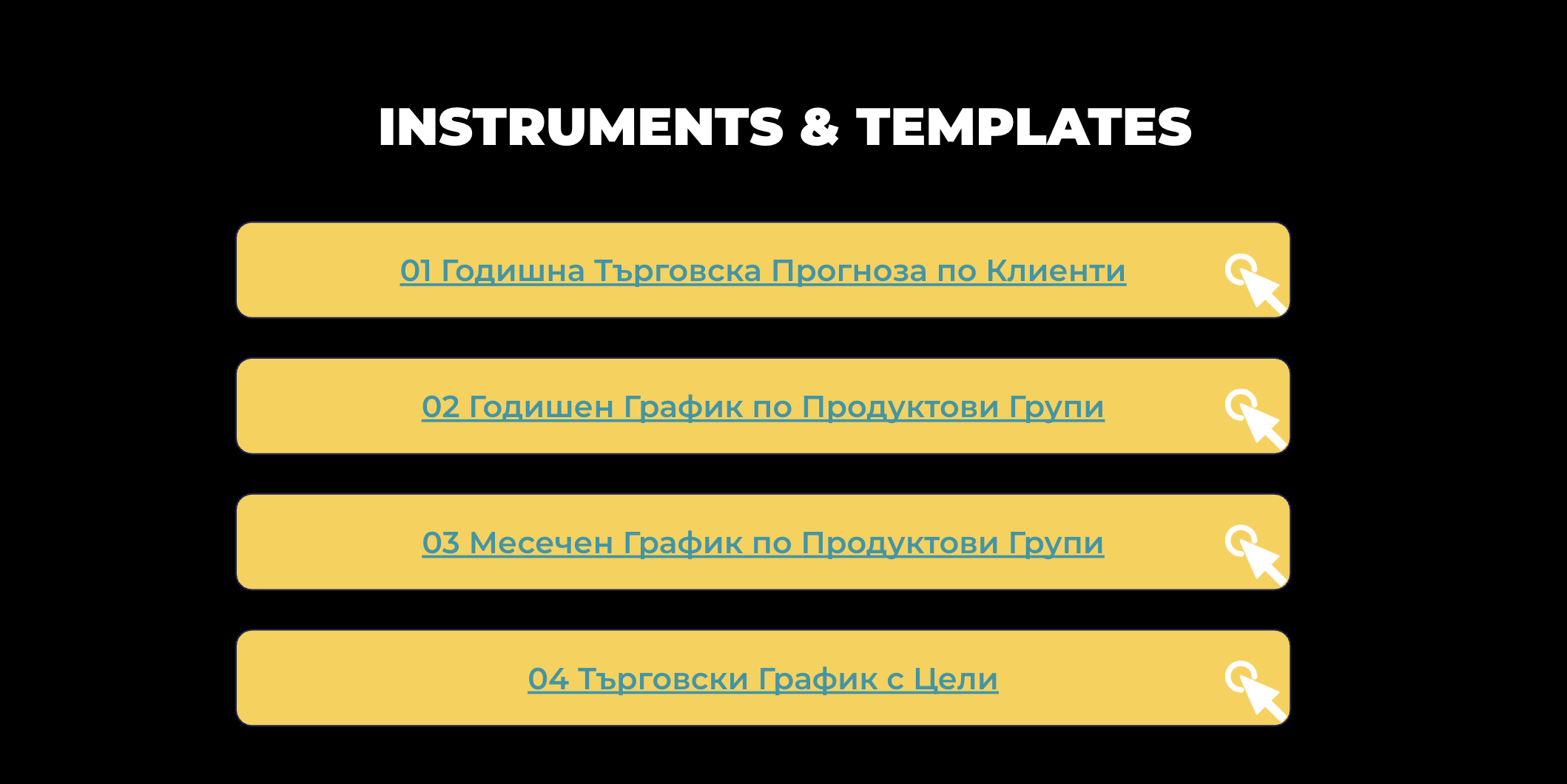
- A comprehensive Execution Playbook:
-
-
- Key processes – charts, step-by-step explanations & templates
- Key meetings schedules and agendas
- All needed templates – annual forecasting template, monthly planning template, goal setting forms, performance tracking forms, etc.
-


The organisation now could move with clarity and confidence.
With the sales teams aligned and the commercial structure in place, Angel returned to the topic we had put on hold at the very beginning:
“The sales teams are now more aligned and structured – it’s time to move to marketing. What’s the right next step?”
This time, we could confidently say: the foundation is ready and the moment is right.
FEEDBACK
“I’m extremely happy that I found you.
You took the time to really understand our business and gave us solutions genuinely tailored to our organization. And then you rolled up your sleeves, guided us, and worked alongside us to make the changes real.
Implementing the changes together was incredibly valuable. You helped us communicate them clearly, handle the resistance, and adapt the process until it began to work. I’m extremely happy with the progress we’ve made so far – and with the partnership we built along the way.”
– Angel Balyo, Founder and CEO, Hellas Hem